
EDITORS NOTE
Retina South Africa: 2025 Highlights
2025 was a year of transition and progress for Retina South Africa.
Leadership Update
Sonya Mahabeer has succeeded Mariza Jurgens as Chair following Mariza’s relocation to Poland. Caryl Baum is now our Vice Chair, joining Sonya, Jean Bowler and Claudette Medefindt on the Executive Committee. Mariza continues to lead our Fundraising and Marketing divisions with passion and success.
Manny Moodley has been appointed as CEO, bringing his longstanding volunteer commitment into a formal leadership position.
Linsay Engelbrecht remains a key driver of our successful Para Sports Development Programme.
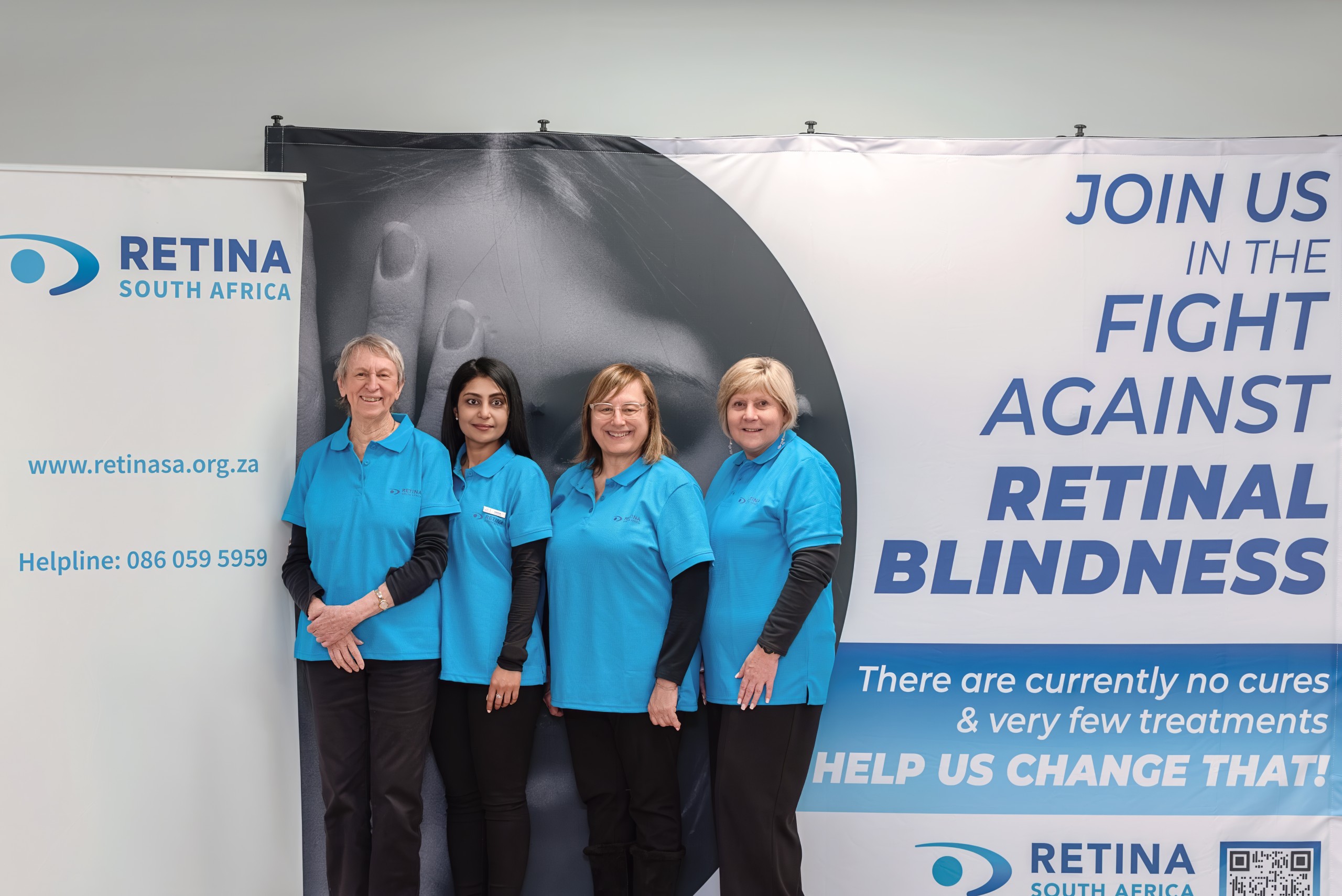
Pictured from left to right, Claudette, Sonya, Caryl and Jean wearing matching blue shirts standing in front of Retina South Africa banners.
Acknowledgements
We gratefully acknowledge a generous bequest from the late Jean Campbell, our first AMD member in the 1980’s.
We thank all our partners, sponsors and donors for their amazing support of our projects, events, and our vision.
We value the collaboration of the Ophthalmology and Optometry professional societies, whose support enhances our credibility and outreach.
To our Management Committee, members, volunteers, supporters, and staff – thank you for your dedication, which brings us closer to treatments and strengthens the support we offer to those navigating life with retinal visual impairment.
Editor
Claudette Medefindt
Tribute to Emeritus Professor Raj Ramesar
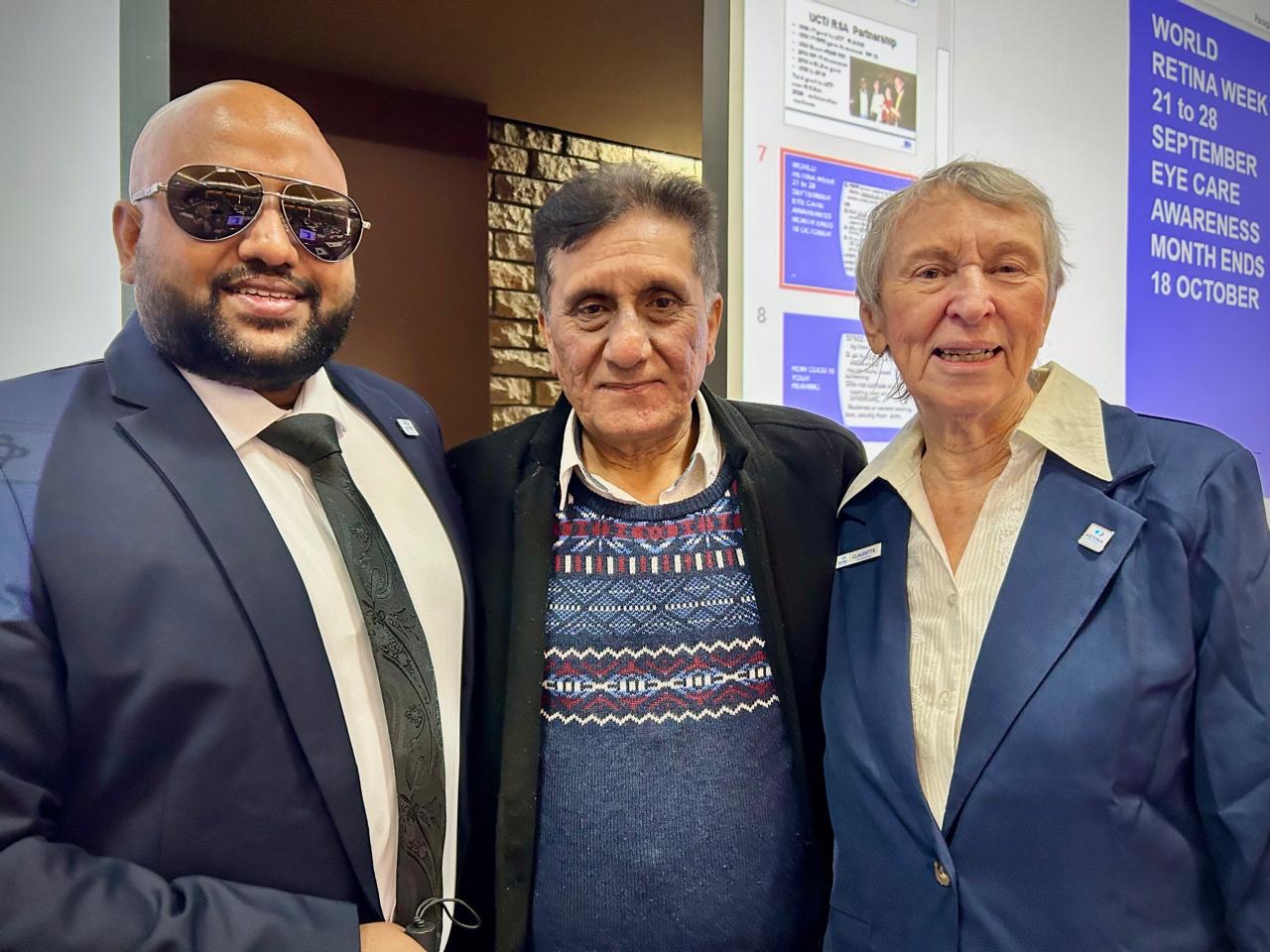
Pictured from left to right Manny, Raj and Claudette
Prof Ramesar has recently retired as Head of the Division of Human Genetics at the University of Cape Town. He has been a bastion of support and advice to Retina South Africa since 1990 and is currently Co-Chair of our Scientific and Medical Advisory Board.
He has driven the IRD project at UCT since its inception in 1992 and together with retired Professor Jacquie Greenberg, and Senior Research Officer Dr Lisa Roberts, they have ensured that hundreds of South Africans with retinal disorders have an accurate genetic diagnosis. Their group at UCT has been a world leader in the search for the elusive genes and mutations that cause inherited vision loss in our South African populations.
TOWARDS TREATMENT
The most frequently asked questions by retinal patients are about treatments. We hope this issue will provide some answers about the most promising global initiatives and, perhaps more importantly, give you trusted sites where you can follow the progress for your own specific condition.
As this information will be general, we encourage patients and families to consult their eye care professional and a genetic counsellor for information specific to their disease. Retina South Africa supports patients with Inherited Retinal Disorders [IRD’s] Age Related Macular Degeneration [AMD] and Diabetes Related [DR] vision loss. We are always available to interpret complex terms and assist you in understanding what steps you can take to ensure that you live your best life with vision loss. Please contact us for counselling and referral to specific service providers.
WHY ARE TREATMENTS NOT YET AVAILABLE?
To understand why, we need to understand the complex structure of the retina and the intricate biological processes that converts photons of light to a detailed visual image in the brain.
WHAT ARE GENES!
These are instructions to make thousands of different proteins that the cells in our bodies need to reproduce and remain healthy. Nearly all cells reproduce but retinal cells are one of the exceptions. We inherit one set of genes from each parent. These sets are called
Chromosomes and are named 1 to 22. We also inherit a gender determining chromosome from each parent.
WHY SHOULD I HAVE A GENETIC TEST!
New Age, sophisticated imaging machines have made specific and accurate diagnosis easier. However, some conditions may still be difficult to pinpoint precisely. A genetic test will confirm a clinical diagnosis.
With this precise diagnosis the risk to family members and children can be accurately assessed by a Genetic Counsellor. The counsellor will also assist with informed reproductive choices. Through genetic testing spouses can be tested to identify carrier status. This can lead to in-vitro fertilisation and pre-impanation tests to ensure that only healthy embryos are implanted and carried to term.
Many treatments will be gene and even mutation specific. For example, on the Foundation Fighting Blindness Clinical Trials pipeline https://www.fightingblindness.org/clinical-trial-pipeline.
Of the 57 trials listed 16 are for AMD only 9 are gene agnostic – for multiple gene types. Gene tests are not available at state hospitals or funded by medical aids – some sponsorship may be available form Retina South Africa. Retina South Africa can assist in self-funding projects.
WHAT TREATMENTS ARE PROMISING FOR GENETIC CONDITIONS
Promising gene based research is under way in gene replacement and gene editing. Both techniques require an accurate genetic diagnosis of the patient. Retina South Africa can facilitate this.
Gene Replacement Therapy [GRT] uses a manipulated virus to deliver a working copy of the gene to the retina. In recessive inheritance no further intervention is required. Over 209 gene therapy trials have been initiated globally to date. GRT targeting single gene IRD’s are more promising, and one treatment for the RPE 65 form of LCA/RP is available in the USA and Europe, but at a huge cost.
To find the status of your IRD [gene specific] see www.fightingblindness.org or www.clinicaltrials.org.
Gene editing is being tested to remove the mutated gene, or section of the gene, and replace with correct genetic information [Cut and Paste concept]. The most promising technique is CRISPR-Cas 9 and a promising clinical trial is under way.
WHAT ARE CLINICAL TRIALS
Clinical trials are extensive patient-based tests to see if promising treatments are effective and safe. Traditionally, they have been in 3 phases starting with low doses, small numbers and patients with severe vision loss and a placebo group that receives a sham treatment. These are necessary but tedious, expensive and strictly controlled by drug registration bodies, the FDA in the USA and the EMA in Europe.
Retina South Africa has participated in a global phase 3 clinical trial for Stargardt Disease and continues to seek more participation. We are only hampered by the number of patients on our database and funding.
STEM CELL THERAPIES
Researchers are trying to regenerate the Retinal pigment epithelium (RPE) and photoreceptor cells. This would benefit people with all types of retinal degeneration.
Retinal cells do not regenerate, and researchers are trying to grow these malfunctioning or dying cells from Embryonic stem cells (ESCs) or induced pluripotent stem cells (iPSCs). ESCs multiply and specialise in the embryo to become one of the 200 plus types of cells in the body. Many types of cells have been successfully grown from stem cells – blood cells, heart muscle cells, and even some nerve cells. Success with retinal cells has not been as successful.
Multiple Phase I/II trials are being tested. Japan and the US lead in ESC/iPSC-based trials, with some showing restored visual function and retinal integration. Some therapies may reach conditional approval by 2026–2027, depending on safety data.
ARTIFICIAL VISION
Artificial vision via electronic implants have been attempted for many years. The most promising approach is the Prima System. The Prima System trials in Europe show partial restoration of central vision in advanced dry AMD. [Seen recently on BBC TV]. This innovative approach uses microprocessors and an infrared light activation device. This means that existing vision is not compromised.
The Prima technology uses a wireless photovoltaic chip inserted under the retina. A pair of external glasses exchanges visual and decoded information with the chip and then via the neural cells and optic nerve to the brain. One year after implantation 27 out of 32 participants could read large print. Extensive training is needed to interpret visual signals, and the cost would be high. As retinal chips in various forms have been studied and sold for many years, hopefully clinical trials will be fast-tracked.
BRAIN IMPLANTS
When the photoreceptors, the neural layer and the optic nerve are damaged, researchers are hoping to bypass the eye completely. A camera and processor are mounted on a pair of glasses that captures visual information and sends it wirelessly to an implant in the visual cortex of the brain. This data is processed and translated into electrical signals that the brain can interpret. The signals are perceived as dots or flashes and the brain would need to be trained to interpret these as patterns of light and motion. This research will probably take years to develop.
OPTOBIONICS
This type of research bypasses the damaged photoreceptors and uses the intact neural cells instead. A light-sensitive protein is delivered to one of the neural layers – usually the ganglion cells.
BIONIC SIGHT for RP
This is a very exciting development from Dr Sheila Nirenberg, who has spent 10 years decoding the retinal messaging system. Her latest clinical trial is testing her Optobionic molecule BSO1 without a coding device. This is a single intravitreal injection which improves the sensitivity of the ganglion cells.
Other promising Optobionic interventions are from Gensight Biologics, Applied Genetic Technologies Corporation (AGTC), Nanoscope, Ray Therapeutics and Kiore.
SUPPLEMENTS
Nutritional interventions are adjuncts not standalone treatments, and your eye care professional must be consulted in this regard.
PROMS [Patient Reported Outcome Measures] have shown for many years the positive effect of antioxidants in retinal vision loss. Glutathione is often called the “Master antioxidant”. It is naturally produced by the liver and is found in all cells. It is a tripeptide made of three amino acids – glutamate, cysteine, and glycine. It is crucial for processes such as immune function, tissue repair and detoxification and is a powerful scavenger of free radicals. It is found in avocados, spinach, kale, asparagus, potatoes, garlic and is also produced by the body from N-Acetyl Cysteine.
Clinical trials to study the effect of N-Acetyl Cysteine in retinal degenerative diseases are ongoing. Once again patients report significant vision improvement.
Lutein and Zeaxanthin are carotenoids found in leafy greens and brightly coloured fruits. They are concentrated in the macula, and act as antioxidants, filtering harmful blue light and neutralizing free radicals that damage retinal cells. Many supplements are available, often in combination with Omega 3. The AREDS2 study confirmed benefits of antioxidant supplementation for intermediate AMD.
Supplement for IRD should contain Lutein, Zeaxanthin, Alpha Lipoic Acid and L-Gluthathion.
LIVING YOUR BEST LIFE
Treatments are now truly within sight but there are measures that patients should take to ensure their health and vision remain optimal.
B= Breathe. Learn deep nostril breathing. It moves your mind and body from the sympathetic stress related “Fight or Flight” state to the parasympathetic, calm “rest and digest” state. Stress has a very negative effect of vision.
E= Exercise. Just move. Run, walk, swim, chair exercises. Also stress relieving and important to control your sugar/insulin balance in the blood.
S= Sleep. During deep Non Rem Sleep your brain is cleansed and many systems in your body are revitalised. The photoreceptor discs are also revitalised. Experts suggest at least 7 hours sleep per night.
T= Tummy. The food that you eat on a daily basis is critical for optimum health and good vision. Eat mostly a plant-based diet, with a focus on colourful, fibre rich plants, seeds, leafy greens and legumes. Oily fish is a good source of Omega 3. Avoid highly processed foods that contain chemical additives – preservatives, colorants, sweeteners, emulsifiers. Reduce sugar and simple starch foods.
For people with ABCA4 gene mutations and people with Cone or Cone Rod Dystrophies do NOT take supplements containing Vitamin A and avoid animal liver products.
T= also for technology. Get smart, get trained. Your smartphone is a free accessibility device. Search for voice assist, magnification and hearing assistance. Free technology for tablets and PC’s is available.
Be sensible about UV and Blue light exposure. After 20 minutes screen time look away for 20 seconds to at least 20 metres, then blink 20 times. Relieves eye muscle strain and dry eyes.
Contact us for advice
WHAT SHOULD YOU DO
Ensure your records at Retina SA are up to date.
Many patients with Stargardt Disease were not contactable for
possible inclusion in the clinical trial.
Register with https://www.fightingblindness.org/my-retina-tracker-registry [preferably with a genetic result].
This confidential portal allows researchers to find you.
Support our events and fundraising initiatives:
Get involved; we always need volunteers.
Join our WhatsApp groups:
You may be able to offer advice to a newly diagnosed person.
Get educated:
Our Retinal Realities and Back to Basics podcasts have great
information and inspiration.
SHARE, LIKE AND FOLLOW US ON SOCIAL MEDIA
YouTube: https://www.youtube.com/@RetinaSA
Facebook: https://www.facebook.co.za/retinasouthafrica
X: https://twitter.com/Retina__SA
LinkedIn: https://www.linkedin.com/company/retina-south-africa
Instagram: https://www.instagram.com/retinasouthafrica
Retinal Realities Facebook: https://www.facebook.com/RetinalRealities/
Retinal Realities Instagram:https://www.instagram.com/retinal_realities_sa/
Retinal Realities X: https://twitter.com/retinal_reality
Retinal Realities Spotify: https://bit.ly/RetinalRealitiesPodcast
Back to Basics Webinars: https://retinasa.org.za/learn/webinars/

The Power of Nutrition for Better Vision: Inside the Nurture Vision Supplement Range
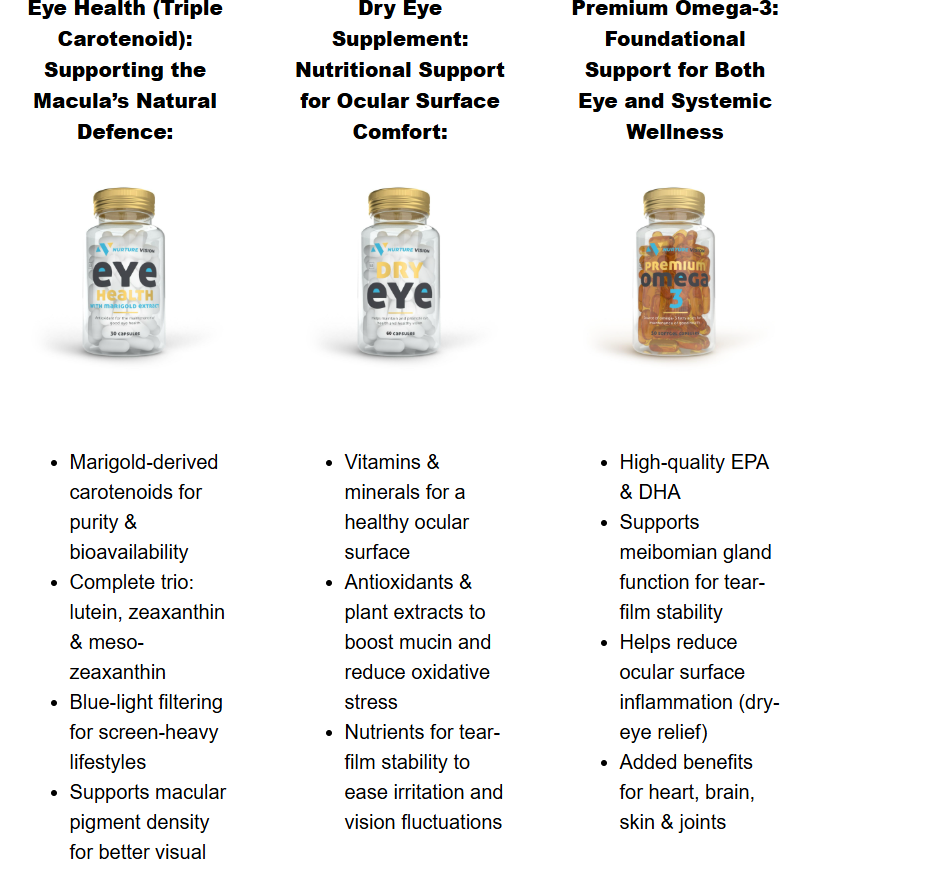
Our Commitment Going Forward:
All Nurture Vision supplements are locally manufactured in South Africa, ensuring both high quality and long-term accessibility for the communities who need them. Our formulations are developed with careful attention to the nutritional needs of the eye and crafted to be simple, practical additions to everyday wellness routines.
We remain grateful for the opportunity to support Retina SA’s work and look forward to continuing this partnership in 2026 as we strive to make proactive eye health more attainable for all.
— The Nurture Vision Team
Retina South Africa Disclaimer
Information disseminated by Retina South Africa is for information purposes only. Readers must discuss any intervention with their Eye Care Practitioner. Information in this E-News does not imply that Retina South Africa endorses any particular therapy, intervention or medication. Retina South Africa assumes no responsibility for the use made of any information provided in this newsletter.
LIKE & FOLLOW ON SOCIAL MEDIA!
|


Copyright (C) @2024 Retina South Africa. All rights reserved.
Tel: +(27) 104979489 | Email: headoffice@retinasa.org.za
www.retinasa.org.za
Our mailing address is:
Retina South Africa
2nd Floor, Sami-G Office Square
80 Greenvale Road
Wilbart, Germiston,
Gauteng, South Africa